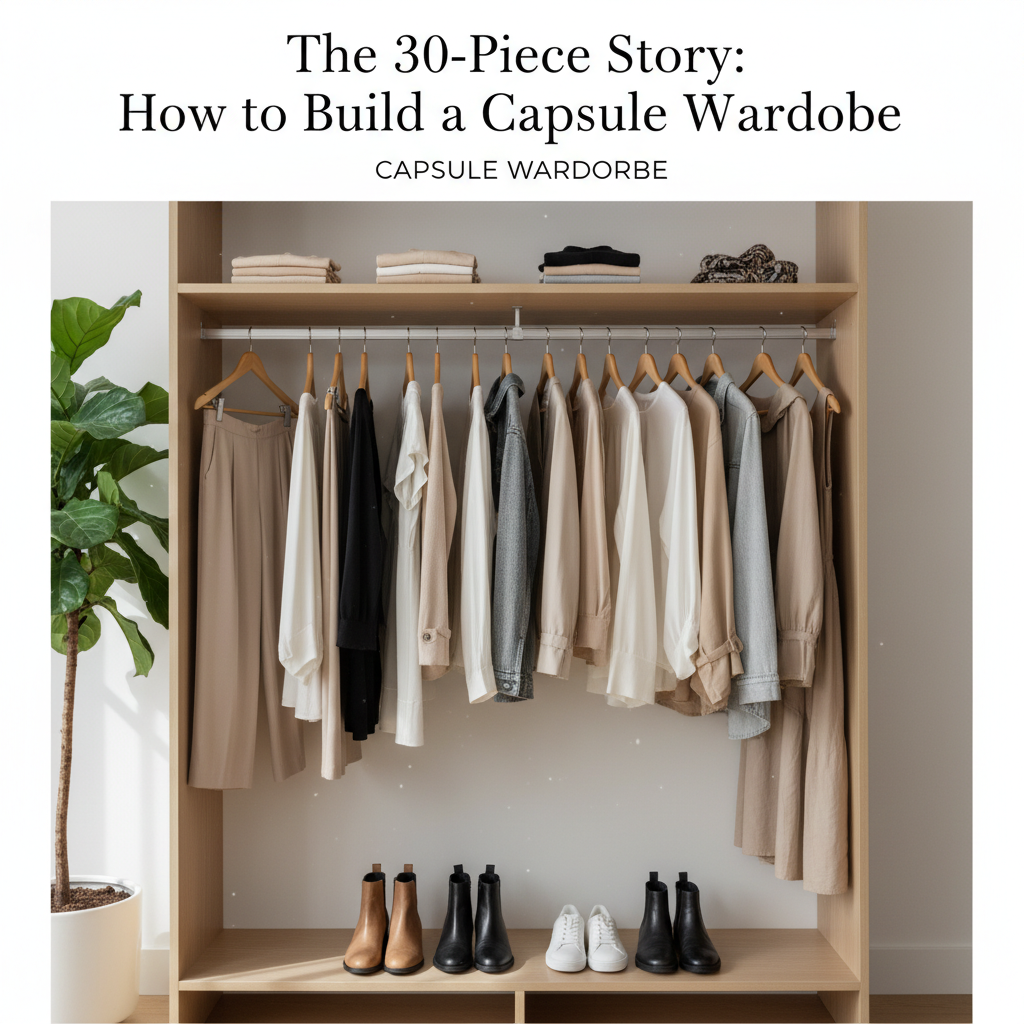
How to Build a 30-Piece Capsule Wardrobe: The Ultimate Guide to Minimalist Style
In an era of hyper-consumption and fast fashion, the closet has become a source of stress rather than joy. Enter the “30-Piece Story”—a narrative of reclaiming your style through the disciplined art of the capsule wardrobe.
We have all experienced the paradox of choice: standing before a bursting closet, hangers jammed together tight, yet feeling utterly convinced that we have nothing to wear. This phenomenon isn’t just a cliché; it is a symptom of decision fatigue. The antidote is not more clothing, but better clothing, curated with intention.

The Philosophy: Why 30 Pieces?
The concept of a capsule wardrobe dates back to the 1970s, credited to London boutique owner Susie Faux. She envisioned a collection of a few essential items of clothing that don’t go out of fashion, such as skirts, trousers, and coats, which can then be augmented with seasonal pieces. This idea was popularized in the US by Donna Karan’s “Seven Easy Pieces” in 1985.
However, the specific “30-Piece” framework brings a modern structure to this vintage concept. Why 30? It strikes a mathematical balance. It provides enough variety to create over 300 unique outfit combinations—enough to go a month without repeating an exact look—while being restrictive enough to force you to define your personal style.
The V&A Museum explores the history of minimalist fashion, highlighting that minimalism isn’t about deprivation; it’s about the elevation of form and function. By limiting yourself to 30 items, you shift your focus from quantity to quality, texture, and silhouette.
Step 1: The Great Purge (The Audit)
You cannot build a sanctuary on a landfill. To begin your 30-piece story, you must first clear the noise. This requires a ruthless audit of your current wardrobe.
- Love: Items that fit perfectly, make you feel confident, and you have worn in the last 30 days.
- Maybe: Items with sentimental value, slight fit issues, or seasonal dependency. Box these up and store them out of sight for 3 months.
- Go: Items that are damaged, ill-fitting, or haven’t been worn in a year. Donate, sell, or recycle.
During this phase, pay attention to fabrics. As discussed in our guide to natural living, opting for natural fibers like cotton, linen, wool, and silk not only ensures longevity but also improves the tactile experience of dressing.
Step 2: Defining Your Aesthetic and Palette
A successful capsule wardrobe relies heavily on cohesiveness. If your 30 items don’t mix and match, you don’t have a capsule; you have 30 separate garments.
The Base Palette
Choose three neutral colors that will form the foundation of your wardrobe. Common choices include Black, Navy, White, Beige, Gray, or Camel. These shades should make up about 60% of your items, particularly bottoms and outerwear.
The Accent Palette
Choose two or three accent colors to add personality. These might be Olive Green, Burgundy, Dusty Rose, or Cerulean. These are best used in tops and accessories. For inspiration on integrating high-end aesthetics with color, consider how a Polène bag in a signature hue can anchor a neutral outfit.
Step 3: The 30 Essentials ( The Blueprint)
While every individual’s lifestyle dictates their specific needs (a lawyer needs more suits than a graphic designer), the following blueprint is a universally adaptable starting point for the 30-piece wardrobe.

Tops (10 Pieces)
Your tops are the most rotated items. They should layer easily under jackets.
- 3 T-Shirts: White, Black, and Grey (High-quality cotton or modal).
- 2 Button-Down Shirts: One crisp white oxford, one silk or chambray.
- 3 Sweaters/Knits: A cashmere crewneck, a chunky turtle neck, and a lightweight cardigan.
- 2 Blouses/Statement Tops: Something with a print or unique texture for evenings out.
Bottoms (8 Pieces)
Fit is paramount here. A pair of jeans that fits perfectly is worth ten that pinch.
- 2 Pairs of Denim: Dark wash straight leg (versatile) and a lighter vintage wash.
- 2 Pairs of Trousers: Black wool trousers and beige/navy chinos or wide-leg pants.
- 2 Skirts: A midi skirt (silk or pleated) and a structured pencil or A-line skirt.
- 1 Dress: The LBD (Little Black Dress) or a wrap dress.
- 1 Seasonal Bottom: Shorts for summer or heavy wool trousers for winter.
Outerwear (5 Pieces)
According to Vogue, outerwear is often the first thing people see; it sets the tone.
- The Trench Coat: Ideally in beige or camel. Waterproof and timeless.
- The Blazer: Black or plaid. Instantly elevates a t-shirt and jeans.
- The Denim or Leather Jacket: For casual, edgy layering.
- The Wool Coat: For colder months.
- The Utility/Puffer Jacket: For purely functional warmth or casual weekends.
Shoes (7 Pieces)
Shoes define the formality of the outfit.
- White Sneakers: Clean, leather, minimal branding.
- Loafers/Mules: For smart-casual office days.
- Ankle Boots: Black leather or suede.
- Heels/Pumps: Nude or black for events.
- Sandals/Flats: For warmer days.
- Statement Boots: Knee-high or combat boots.
Note: Accessories like scarves, jewelry, and bags (such as a stunning beaded bag for evening wear) are generally not counted in the strict 30-piece limit, allowing you to change the “flavor” of the outfit without adding bulk.
Step 4: The Art of Mixing and Matching
The magic of the capsule wardrobe lies in the “multiplier effect.” Because you have adhered to a strict color palette, your white shirt matches all 8 of your bottoms. Your blazer goes with your jeans, trousers, and skirts.
The Rule of Thirds: When dressing, visualize your body in thirds. A crop jacket and high-waisted trousers create a 1/3 to 2/3 ratio, which is visually lengthening. A long tunic over trousers creates a 2/3 to 1/3 ratio. The capsule wardrobe makes achieving these proportions easier because the silhouettes are chosen to complement one another.
The New York Times suggests treating your wardrobe like a menu; you have the ingredients, now you just need to plate the dish differently. A silk slip dress is evening wear with heels, but becomes daytime appropriate when layered over a white tee with sneakers.

Investment vs. Cost-Per-Wear
The initial sticker shock of building a high-quality capsule wardrobe can be daunting. Spending $200 on a pair of denim seems excessive compared to fast fashion prices. However, the metric to use is Cost Per Wear (CPW).
“If you buy a $200 pair of jeans and wear them 100 times, the cost per wear is $2. If you buy a $40 pair of trendy pants and wear them twice, the cost per wear is $20.”
By committing to 30 pieces, you are committing to wearing them. This justifies investing in better fabrics, ethical production, and superior tailoring. It shifts the economic model of your household from consumption to utilization.
Maintenance: Caring for Your Capsule
With fewer clothes, each piece undergoes more stress. Maintenance becomes a ritual.
- Wash Less: Denim and wool do not need to be washed after every wear. Spot clean and air out fabrics to preserve fibers.
- Invest in Tools: A steamer, a fabric shaver (for sweater pills), and high-quality wooden hangers are non-negotiable.
- The Seasonal Swap: At the end of a season, inspect your 30 pieces. Repair loose buttons immediately. Dry clean coats before storing them to prevent moth damage.
Conclusion: The Freedom of Limits
The 30-Piece Story is not about restriction; it is about liberation. It liberates you from the morning panic of “nothing to wear.” It liberates your bank account from impulse buys. Most importantly, it liberates your mind. When you strip away the excess, you are left with a visual representation of who you actually are, not who you thought you might be when you bought that neon blouse on sale three years ago.
Start your story today. Open your closet, take a deep breath, and begin the edit.
Leave a Reply