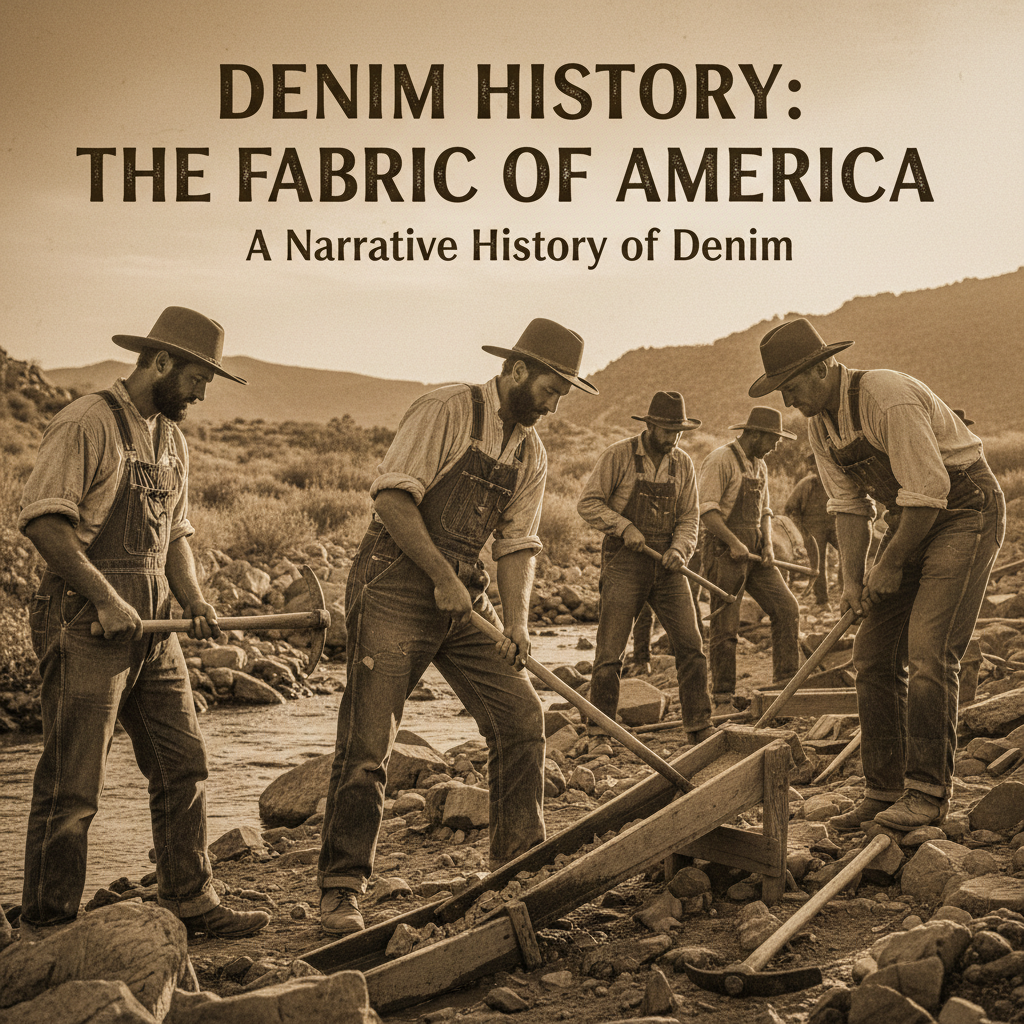
Denim History: The Fabric of America – A Narrative Journey
From the depths of Genoese harbors to the gold mines of California and the runways of Paris, we explore the rugged, rebellious, and revolutionary tale of the world’s most iconic textile. This is “Denim History: The Fabric of America: A Narrative History of Denim.”
There is perhaps no garment more ubiquitous, more democratic, and yet more paradoxically complex than the blue jean. It is a garment that has clothed the gold miner and the supermodel, the cowboy and the rock star, the president and the protestor. To trace the lineage of this textile is to trace the lineage of modern industrial civilization itself. Denim History: The Fabric of America: A Narrative History of Denim is not merely a chronicle of pants; it is a story of globalization, rebellion, and the shifting identity of the American Dream.
While often regarded as a purely American invention, the story of denim begins centuries before the founding of the United States, woven into the trade routes of Europe. Yet, it was on American soil that this fabric was transfigured from simple utility cloth into a cultural icon. This narrative explores how a sturdy cotton twill conquered the world, becoming the literal and metaphorical fabric of our lives.
I. Serge de Nîmes: The European Progenitors
Long before Levi Strauss set foot in California, the precursors to denim were being utilized by the working class of Europe. The etymology itself provides the map of its origin. The word “denim” is widely accepted as an anglicization of serge de Nîmes, a sturdy fabric produced in the French textile town of Nîmes. This “serge” was a wool and silk blend initially, eventually evolving into a cotton twill known for its durability.
Simultaneously, in the Italian city of Genoa, sailors were utilizing a fustian cloth—a heavy cotton fabric—to protect their goods and themselves from the harsh maritime elements. The French name for Genoa is Gênes, which phonetic evolution eventually anglicized into “jeans.” Thus, the linguistic DNA of our modern wardrobe is a hybrid of French manufacturing and Italian maritime utility.
However, these European fabrics were merely the ancestors. They lacked the defining characteristic of modern denim: the unique indigo dying process where the warp threads are dyed blue and the weft threads remain white, creating that distinct, fading character we cherish today. For the true birth of the “blue jean” as we know it, we must travel to the American West.

II. The Rivet Heard ‘Round the World (1873)
The year is 1853. Levi Strauss, a Bavarian immigrant, arrives in San Francisco at the height of the California Gold Rush. He establishes a dry goods wholesaling business, supplying the teeming masses of prospectors with supplies—tents, bedding, and fabric. The miners, kneeling in riverbeds and scraping against rock, faced a consistent problem: their trousers fell apart.
Enter Jacob Davis, a tailor from Reno, Nevada. Davis had purchased cloth from Strauss to make tents and wagon covers. One day, a miner’s wife asked Davis to make a pair of pants for her husband that wouldn’t fall apart. Davis had an epiphany. He reinforced the stress points—the pockets and the base of the button fly—with copper rivets utilized for horse blankets. The result was indestructible.
Davis knew he had a revolutionary idea but lacked the funds to patent it. He wrote to his supplier, Levi Strauss, suggesting they hold the patent together. On May 20, 1873, they received U.S. Patent No. 139,121 for an “Improvement in Fastening Pocket-Openings.” This date is arguably the most significant in Levis Strauss & Co. history, marking the official birth of the blue jean.
“The rivets were the game-changer. Before 1873, work pants were disposable. After 1873, they became an investment in labor.”
Initially called “waist overalls,” these garments were made from 9 oz. XX blue denim from the Amoskeag Mill in New Hampshire. They were purely functional. The indigo color was chosen not for fashion, but because it hid dirt and stains better than lighter fabrics—a crucial feature for men moving earth in search of gold. For a deeper dive into this era, the Smithsonian Institution provides an extensive archive of early workwear artifacts.
III. From the Mine to the Movie Screen: 1900-1940
As the Gold Rush subsided, the “waist overalls” found a new demographic: the American Cowboy. The durability that served the miner served the ranch hand equally well. As the mythology of the Wild West began to permeate American culture through dime novels and early cinema, the denim-clad cowboy became a symbol of rugged independence.
In the 1930s, as the Dude Ranch craze hit, wealthy Easterners vacationing in the West brought “dungarees” back home as souvenirs. Denim began its slow creep from pure utility into the realm of casual wear. Vogue magazine even featured its first hint of “Western chic” during this era, foreshadowing the high-fashion takeover decades later.
World War II further cemented denim’s place in the American psyche. The U.S. government declared denim an essential commodity for the war effort. Soldiers wore denim when off-duty, and the iconic “Rosie the Riveter” wore denim coveralls, symbolizing the strength of the American workforce. When GIs returned home, they brought their love for the comfortable, durable fabric to the suburbs.

IV. The Rebel Yell: The 1950s
If the 1940s introduced denim to the suburbs, the 1950s banned it from the schools. This was the era where denim transitioned from a symbol of labor to a symbol of rebellion. Hollywood played the catalyst.
When Marlon Brando appeared in The Wild One (1953) and James Dean in Rebel Without a Cause (1955), they weren’t wearing suits; they were wearing T-shirts and blue jeans. They represented a dangerous, sexually charged, anti-authoritarian youth culture. Suddenly, “Denim History: The Fabric of America” took a sharp turn. It was no longer the fabric of the compliant worker; it was the uniform of the delinquent.
Many school boards across the U.S. banned denim, which, naturally, only made it more desirable to teenagers. This cemented the jean as the garment of youth, a distinction it has never really lost. As noted in Vogue’s analysis of denim history, this was the moment fashion overtook function.
V. The Democratization and Designer Boom (1960s-1980s)
By the 1960s, the rebellion had morphed. Jeans became the uniform of the Civil Rights movement and the anti-war protests. Activists wore denim to show solidarity with the working class. The personalization of denim—embroidery, patches, bell-bottom cuts—reflected the psychedelic individualism of the era.
Then came the 1970s and 1980s, bringing the “Designer Jean.” Brands like Calvin Klein, Gloria Vanderbilt, and Jordache took the humble work pant, cut it tighter, slapped a logo on the back pocket, and sold it for a premium. This was the commercialization of cool. Brooke Shields famously declared, “You want to know what comes between me and my Calvins? Nothing.” Denim had become sexy.
During this time, denim also became the foundational canvas for accessories. Just as a Polène bag today signifies a specific aesthetic of modern minimalism, or a intricate beaded bag signals bohemian flair, the cut and brand of your jeans in the 80s defined your social standing.

VI. Understanding the Fabric: Warp, Weft, and Selvedge
To truly appreciate “Denim History: The Fabric of America: A Narrative History of Denim,” one must understand the textile science displayed in the image above. Denim is a warp-faced cotton twill.
- The Warp: The vertical threads, dyed with indigo. Because the dye sits on the surface of the thread (ring dyeing), it chips away over time, creating the “fades” enthusiasts love.
- The Weft: The horizontal threads, traditionally left undyed (white). This is why the inside of your jeans looks white.
- Selvedge: Short for “self-edge.” Produced on old-school shuttle looms, this denim has a tightly woven edge that doesn’t unravel. It is the hallmark of high-quality, heritage denim production.
In the modern era, there has been a resurgence of interest in raw, organic materials. Much like the movement towards natural living and sustainable home goods, denim purists are returning to raw, selvedge denim that requires months of breaking in, rejecting the pre-distressed fast fashion that dominates the mall.
VII. The Future: Sustainability and Innovation
The history of denim is not without its dark side. The production of denim is incredibly water-intensive—it can take up to 1,800 gallons of water to grow the cotton and manufacture a single pair of jeans. Furthermore, the synthetic indigo and chemical distressing processes have caused significant environmental damage in manufacturing hubs.
However, the narrative is shifting again. As reported by the BBC, the industry is undergoing a revolution. Laser technology is now used to distress jeans without water or chemicals. Brands are experimenting with hemp blends, recycled cotton, and waterless dyeing techniques. The “Fabric of America” is adapting to the existential threat of climate change, aiming to become the Fabric of a Sustainable Future.
Conclusion: The Enduring Legacy
From the depths of the earth in the California Gold Rush to the heights of haute couture, denim has traveled a trajectory unlike any other fabric. It is a canvas upon which we project our identities. It is the clothing of the worker, the rebel, the supermodel, and the everyman.
Denim History: The Fabric of America: A Narrative History of Denim proves that while fashions fade, true style—and durability—is eternal. As we look to the future, the blue jean remains a testament to human ingenuity and the desire for a garment that lives, breathes, and ages alongside us.
Leave a Reply