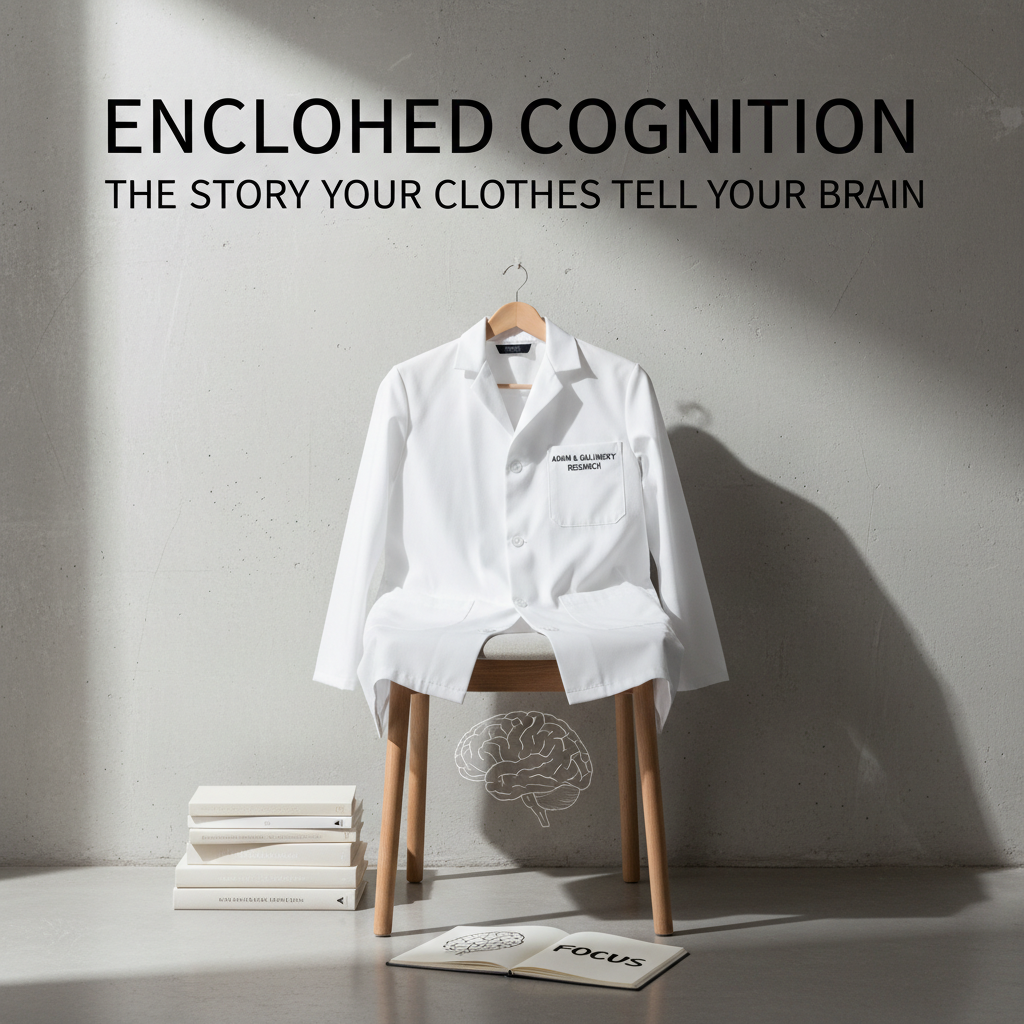
Enclothed Cognition: The Story Your Clothes Tell Your Brain
We have all experienced the transformation. It occurs in the quiet moments before a mirror, midway through the morning routine. You shed the worn, soft cotton of your sleepwear and step into the structured architecture of a blazer, or perhaps slip into the purposeful silhouette of athletic gear. In that instant, something shifts. It is not merely your reflection that changes; it is your internal narrative.
For decades, the fashion industry has sold us on the idea of “dressing for success” as a method of influencing others. We are told to dress for the job we want, not the job we have, implying that clothing is primarily a signal broadcast to the outside world—a tool for social maneuvering and status signaling. While valid, this perspective ignores a far more profound psychological phenomenon occurring beneath the fabric: the conversation happening between you and yourself.
This phenomenon is known in psychological circles as Enclothed Cognition: the story your clothes tell your brain. It is the scientific validation of the feeling that you are a different person in a tuxedo than you are in sweatpants. It posits that clothing does not just reflect who we are; it actively shapes who we are becoming in the moment, altering our neural pathways, attention spans, and confidence levels.
The Scientific Origins: The Lab Coat Effect
The term “enclothed cognition” was first formally introduced in 2012 by researchers Hajo Adam and Adam Galinsky. Their groundbreaking study, published in the Journal of Experimental Social Psychology, sought to move beyond the vague notion of “looking good to feel good” and instead measure cognitive performance changes based on attire.

In their now-famous experiment, Adam and Galinsky gathered a group of undergraduates and presented them with a simple white coat. For half the participants, the coat was described as a “doctor’s coat.” For the other half, the exact same garment was described as a “painter’s coat.”
The results were startling. The participants wearing the “doctor’s coat” demonstrated significantly higher levels of sustained attention and focus during complex tasks compared to those wearing the “painter’s coat” or those who merely saw the coat on a desk. The physical experience of wearing the garment, combined with the symbolic association of a doctor—careful, rigorous, intelligent—actually enhanced the wearer’s cognitive abilities.
“Clothes invade the body and brain, putting the wearer into a different psychological state.” — Hajo Adam & Adam Galinsky, Journal of Experimental Social Psychology
This study revealed that enclothed cognition depends on two co-occurring factors: the symbolic meaning of the clothes and the physical experience of wearing them. You cannot simply look at the suit to feel powerful; you must feel the weight of the wool on your shoulders. Conversely, wearing the suit without knowing its cultural context renders it psychologically inert. It is the marriage of symbol and sensation that rewrites the brain’s software.
The Psychology of the “Power Suit” vs. Loungewear
To understand how this applies to daily life, we must look at the spectrum of formality. Why do we feel “sharper” in tailored clothing? According to research from Oxford Academic’s Journal of Consumer Research, formal clothing enhances abstract cognitive processing. When we dress formally, we tend to think more broadly, strategically, and creatively. We adopt a position of social power, which creates a psychological distance, allowing us to see the “big picture” rather than getting bogged down in minute details.
However, the narrative has shifted in the post-2020 world. The global transition to remote work challenged the traditional definitions of professional attire. Suddenly, the boardroom was replaced by the bedroom, and the Italian loafer was swapped for the fuzzy slipper.

As reported by The New York Times, this shift blurred the boundaries of enclothed cognition. Without the ritual of dressing for work, many employees found their work-life balance deteriorating. The brain, lacking the sartorial cue that “work has begun,” struggled to enter a flow state. Conversely, without changing out of work clothes, the brain failed to signal that “rest has begun.”
This brings us to the concept of contextual dressing. If you wear your relaxation clothes (sweatpants) to perform high-stress tasks (Zoom meetings), you are sending conflicting signals to your amygdala. The fabric says “rest,” but the screen says “perform.” This dissonance generates low-grade anxiety and fatigue.
Totems of Identity: The Role of Accessories
Enclothed cognition is not limited to garments that cover the torso or legs; it extends to the accessories we carry, which serve as totems of our identity. Consider the psychological weight of a handbag. It is a vessel of privacy and a badge of taste.
Carrying a structured, architectural piece, such as a Polene bag, reinforces a self-image of organization, modernism, and high status. The rigid lines and smooth leather provide tactile feedback that suggests control and precision. When your hand grips that handle, your posture often subtly corrects itself; you walk with greater intention.
In contrast, opting for something intricate and artistic, like a beaded bag, tells your brain a story of creativity, playfulness, and social connectivity. The texture of the beads against the fingers acts as a fidget tool, potentially stimulating creative thought processes and reducing social anxiety during networking events. These items are not mere containers for keys and lipstick; they are psychological anchors that ground the wearer in a specific identity.
Fabric, Texture, and Neural Pathways
While symbolism is powerful, we cannot underestimate the raw, biological input of touch. Our skin is our largest organ, and it is in constant contact with what we wear. This sensory input travels directly to the brain, influencing neurotransmitter activity.
This connects deeply with the philosophy of natural living. Proponents of natural living often advocate for organic fibers—linen, wool, silk, and cotton—not just for environmental reasons, but for the clarity of mind they offer. Synthetic fabrics like polyester often trap heat and moisture, creating a micro-climate of discomfort that the brain registers as low-level stress. This “background noise” of physical discomfort consumes cognitive resources that could otherwise be used for focus or emotional regulation.

Linen, for example, is breathable and irregular in texture. Wearing it often signals “leisure” or “summer” to the brain, triggering the parasympathetic nervous system to relax. Heavy wool, with its weight and warmth, can trigger a feeling of security and containment, much like a weighted blanket, which can be grounding in high-anxiety environments.
In The Atlantic’s analysis of the lab coat effect, the tactile experience was paramount. If the coat felt cheap or costume-like, the effect diminished. Authenticity matters to the brain. If the fabric feels authentic, the role you are playing feels authentic.
Curating a Mindset Wardrobe
Understanding enclothed cognition empowers us to hack our own psychology. We can curate a wardrobe not based on trends, but on the mental states we wish to inhabit. Here is a framework for applying this science to your daily life:
1. The Focus Uniform
Identify an outfit that you associate with your most productive moments. For many, this is a blazer or a specific pair of glasses. Dedicate this outfit strictly to “deep work.” Over time, putting on this item will become a Pavlovian trigger, instantly dropping your brain into a state of concentration.
2. The Armor of Confidence
When facing a negotiation or a difficult conversation, utilize structure. Structured shoulders, collars, and heavier fabrics (denim, wool, leather) provide a sensation of physical boundaries. This “armor” helps maintain emotional distance and reduces the feeling of vulnerability.
3. The Creative Softener
When brainstorming or engaging in artistic endeavors, constriction is the enemy. Tight waistbands or stiff collars can subconsciously signal “restriction” to the brain, inhibiting lateral thinking. Opt for loose silhouettes and tactile textures that encourage movement and flow.
4. The Ritual of Removal
Just as important as putting clothes on is taking them off. To preserve your mental health, establish a ritual of changing clothes immediately when the work day ends. This physical shedding of the “work self” signals the brain to stop processing professional anxieties and begin the restoration phase.
Conclusion: You Are What You Wear
The adage “clothes make the man” is incomplete. Clothes do not just make the man; they mold the mind. Enclothed cognition: the story your clothes tell your brain is a continuous narrative loop. You choose the clothes, and then the clothes choose your mindset.
In a world that is increasingly digital and abstract, the tangible reality of what we wear remains one of the few things we can control. By choosing our garments with intention—weighing the symbolism of a blazer, the luxury of a Polene bag, or the breathability of natural linen—we are not just styling our bodies. We are curating our consciousness.
So, the next time you stand before your closet, ask yourself not just “How do I look?” but “Who do I want to be today?” Your brain is listening.
Frequently Asked Questions
Mohsin Naqwi is a writer and researcher specializing in the intersection of psychology, lifestyle, and design. With a focus on how our environment and sartorial choices influence human behavior, Mohsin translates complex psychological theories into actionable lifestyle strategies.
Leave a Reply