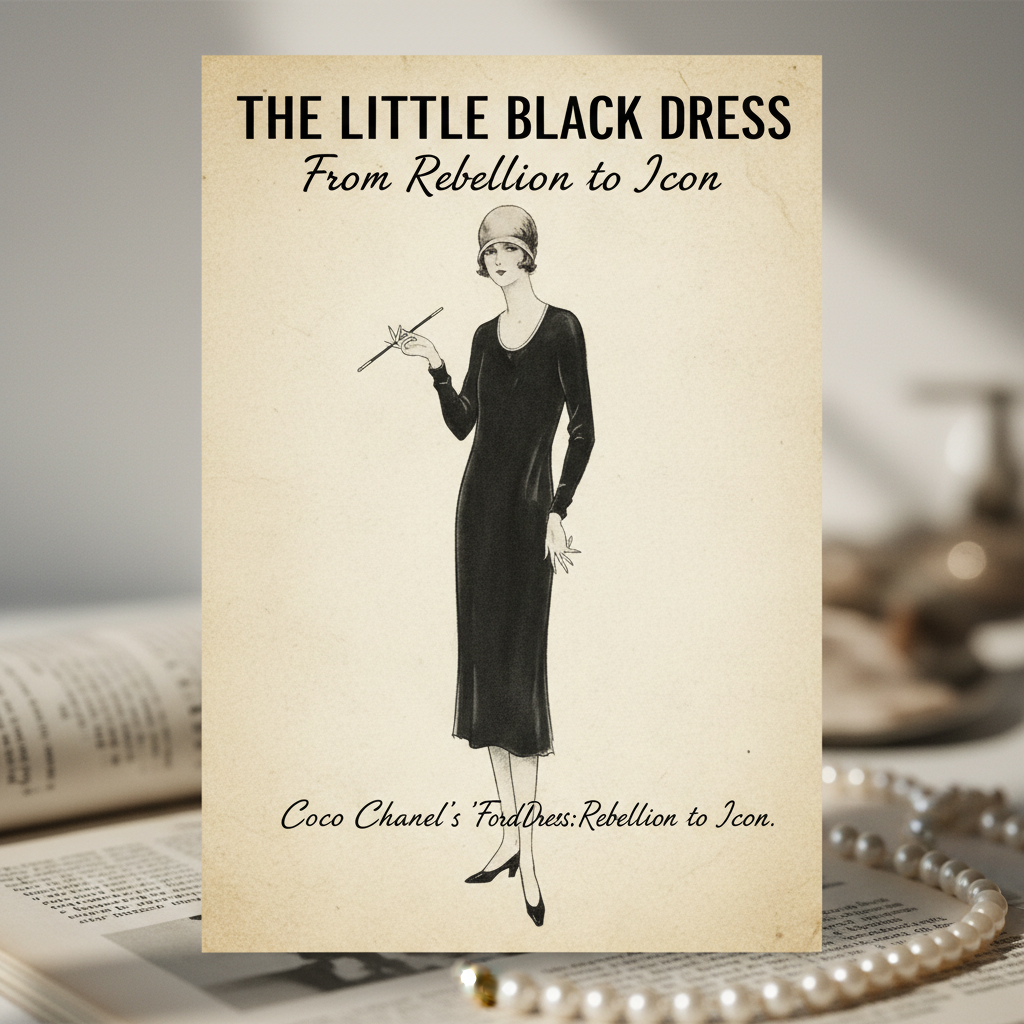
The Story of the Little Black Dress: From Rebellion to Icon
Few garments in the history of sartorial expression claim a status as legendary as the Little Black Dress (LBD). It is more than a piece of clothing; it is a cultural phenomenon, a social equalizer, and a canvas upon which a century of history has been painted.
To understand the magnitude of its influence, one must look beyond the fabric and silhouette. The story of the little black dress from rebellion to icon is a narrative of women’s liberation, the democratization of luxury, and the enduring power of minimalism. From the roaring twenties to the digital age, the LBD has remained the singular wardrobe essential that refuses to age.
But how did a color explicitly reserved for mourning and servitude become the ultimate symbol of chic? This comprehensive history explores the radical evolution of fashion’s most enduring staple.
1. The Pre-1920s: A Color of Sorrow and Service
Before the 1920s, black was strictly codified in Western society. It was the color of grief, the hue of the clergy, and the uniform of the domestic servant. In the Victorian era, mourning dress was a rigid societal obligation. A widow was expected to wear heavy, non-reflective black crepe for at least two years. To wear black outside of these parameters was considered socially inappropriate, signaling either a lack of imagination or a melancholic disposition.
Furthermore, the fashion of the early 20th century—the Edwardian era—was defined by excess. Women were encumbered by hobble skirts, massive hats adorned with taxidermy, and layers of pastel lace. It was a time of “more is more.” The idea that a woman would voluntarily choose a stark, unadorned black sheath was practically unthinkable. The color black erased the wearer in a society that expected women to be decorative objects.
2. 1926: The Chanel Revolution
The pivotal moment in the story of the little black dress from rebellion to icon occurred in October 1926. Vogue published a sketch of a simple, calf-length black sheath dress designed by Gabrielle “Coco” Chanel. It was long-sleeved, devoid of fringe or buttons, and made of Crêpe de Chine.

Vogue famously dubbed it “Chanel’s Ford,” referencing the Model T car that was accessible to the masses and available only in black. The magazine prophesied that this dress would become “a sort of uniform for all women of taste.”
This was a radical act of rebellion. Chanel took the color of the servant and the widow and repurposed it as the color of the modern, independent woman. By stripping away the corset and the superfluous decoration, Chanel gave women mobility. The LBD was not just a dress; it was a political statement. It declared that a woman’s elegance came from her person, not the complexity of her attire.
The Great Depression and Utility
As the decadence of the Jazz Age gave way to the Great Depression, the LBD transitioned from a high-fashion novelty to a necessity. Its affordability and versatility meant that a woman could own one dress and, by changing accessories—perhaps adding a vintage beaded bag or a string of pearls—appear appropriate for both a job interview and a cocktail party. The economic crash cemented the black dress as a survival tool for the stylish woman.
3. The Post-War “New Look” and Hollywood Glamour
Following World War II, Christian Dior introduced the “New Look” in 1947. While Chanel had favored a loose, boxy silhouette, Dior brought back the cinched waist and the full skirt. However, he kept the black. Dior once stated, “You can wear black at any time. You can wear it at any age. You may wear it for almost any occasion.”
During the 1950s, Hollywood played a massive role in elevating the LBD to sultry heights. Actresses like Marilyn Monroe and Rita Hayworth used black dresses to project a dangerous kind of glamour—the “Femme Fatale” archetype of film noir. The dress was no longer just practical; it was seductive.
4. The Breakfast at Tiffany’s Era
If Chanel invented the LBD, Hubert de Givenchy and Audrey Hepburn perfected it. The opening scene of the 1961 film Breakfast at Tiffany’s remains perhaps the most famous fashion moment in cinema history. Hepburn, standing outside the jewelry store in the early morning, wears a black satin sheath dress designed by Givenchy, paired with elbow-length gloves and pearls.
This moment solidified the LBD as the pinnacle of sophistication. It proved that the dress could be aspirational. It was the antithesis of the “rebellion” of the 20s; it was now the establishment standard of good taste. Just as effective short story writing requires stripping away the unnecessary to reveal the core narrative, the Givenchy LBD stripped away ornamentation to reveal the woman’s inherent grace.
5. The Late 20th Century: Punk, Grunge, and Revenge
The latter half of the 20th century saw the LBD fragmented into dozens of subcultures. In the 1970s and 80s, ripped black dresses became the uniform of the punk movement, reclaiming the “rebellion” aspect of the garment’s history. Designers like Azzedine Alaïa crafted body-conscious black dresses that celebrated the female form with aggression and power.
Perhaps the most famous specific LBD of the 90s was Princess Diana’s “Revenge Dress.” Worn to the Serpentine Gallery on the night Prince Charles confessed his adultery on national television, the off-the-shoulder Christina Stambolian dress was a masterclass in fashion psychology. It weaponized the LBD, proving that looking your best is the ultimate retribution.
Later in the 90s, the “heroin chic” aesthetic and minimalism saw the LBD reduced to a simple slip dress, championed by icons like Kate Moss and Jennifer Aniston.
6. The Modern Era: Versatility and Sustainability
Today, the story of the little black dress from rebellion to icon continues to evolve. In the 21st century, the conversation has shifted toward sustainability and the “capsule wardrobe.” The LBD is the hero of the sustainable closet because it transcends trends. A well-made black dress bought today will be wearable in twenty years.

Modern designers are experimenting with textures—leather, latex, velvet, and sustainable organic cottons—to keep the concept fresh. The styling has also evolved. While pearls are classic, the modern woman is just as likely to pair her LBD with combat boots or a structural, minimalist accessory like a Polène bag to create a look that balances femininity with architectural edge.
Why It Will Never Go Out of Style
According to fashion historians at the Metropolitan Museum of Art, the persistence of the LBD lies in its ability to absorb meaning. It is a blank slate.
- Psychology of Color: Black is associated with authority, intelligence, and sleekness.
- Economy: It hides stains and wears well, making it practical.
- Focus: It draws attention to the wearer’s face and eyes, rather than the body alone.
Conclusion
From the mourning weeds of the Victorian widow to the defiance of Coco Chanel, and from the glamour of Audrey Hepburn to the power moves of Princess Diana, the Little Black Dress has lived a thousand lives. The story of the little black dress from rebellion to icon is ultimately a reflection of women’s history over the last century.
It survived the Great Depression, World Wars, and the fluctuating hemline index of the stock market. It remains the one item in a closet that never asks to be replaced, only reinvented. As Karl Lagerfeld famously said, “One is never over-dressed or under-dressed with a Little Black Dress.”
Leave a Reply