The Power of a Personal Uniform: Lessons from the Steve Jobs Story
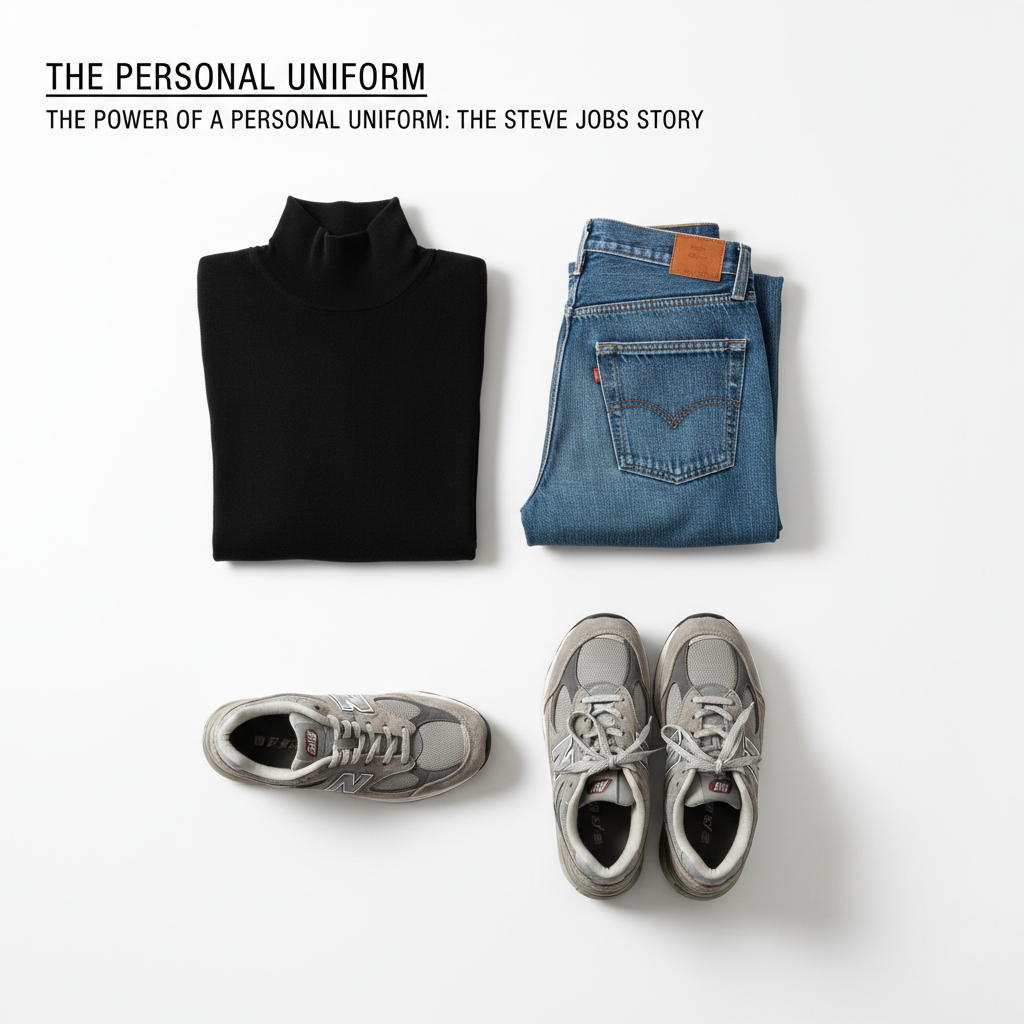
In the annals of modern business history, few images are as instantly recognizable as the silhouette of Steve Jobs on a keynote stage. The lighting was always dramatic, the slides were always minimal, and the man himself was always the same. He did not wear a rotating cast of Italian suits or seasonal trends. He wore a black mock turtleneck, blue Levi’s 501 jeans, and gray New Balance sneakers.
This was not merely a lack of interest in fashion. It was a deliberate, calculated, and philosophical choice that has since inspired a movement among entrepreneurs, creatives, and minimalists worldwide. The Steve Jobs story regarding his attire is about much more than clothing; it is a masterclass in branding, essentialism, and the psychological concept of decision fatigue.
In a world that constantly demands our attention and forces us to make thousands of micro-decisions before noon, the concept of the “Personal Uniform” offers a liberating alternative. It suggests that by constraining our choices in one area of life, we expand our capacity for greatness in others.
 The Power of a Personal Uniform: The Steve Jobs Story visualized through his signature black turtleneck, Levi’s, and New Balance sneakers.
The Anatomy of the Uniform
Before diving into the psychology, it is essential to understand the specificity of the uniform. Jobs didn’t just grab any black shirt. His uniform was curated with the same perfectionism he applied to the iPhone.
- The Turtleneck: Specifically, a black mock turtleneck designed by the legendary Japanese designer Issey Miyake. It wasn’t cotton; it was a specific blend that draped in a way Jobs preferred.
- The Jeans: Classic Levi’s 501s. Utilitarian, American, and democratic. They signaled that despite being a billionaire, he was still a builder at heart.
- The Shoes: New Balance 991 sneakers in gray. Comfortable, supportive, and decidedly “dad-core” before the term existed.
According to Walter Isaacson’s biography, Jobs famously had hundreds of these turtlenecks stacked in his closet. This wasn’t about wearing the same shirt every day; it was about wearing the same style every day. This distinction is crucial for anyone looking to adopt this lifestyle.
Key Takeaway: A personal uniform does not mean poor hygiene or wearing worn-out clothes. It means identifying a combination of items that make you feel confident and comfortable, and then buying them in bulk.
The Psychology: Defeating Decision Fatigue
Why would a man with nearly unlimited resources choose to limit his wardrobe so severely? The answer lies in cognitive psychology. There is a phenomenon known as decision fatigue. The theory posits that the human brain has a finite amount of “executive function” or decision-making power each day.
Every choice you make consumes a unit of this energy. Should I hit snooze? Eggs or oatmeal? Blue shirt or white shirt? Which route to work? By the time you sit down at your desk, you may have already depleted a significant portion of your mental stamina.
For a CEO like Jobs, whose decisions involved billions of dollars and the future of consumer technology, wasting neural energy on choosing an outfit was an unaffordable luxury.
 The Power of a Personal Uniform: Comparing a simplified wardrobe to a cluttered closet to illustrate how the Steve Jobs approach reduces decision fatigue.
As noted in recent BBC Worklife articles, adopting a uniform is an act of cognitive conservation. It automates the mundane so that the brain can focus on the profound. This is similar to the principles discussed in natural living, where simplifying one’s environment leads to greater mental clarity.
The Origin Story: A Failed Corporate Uniform
The Steve Jobs story regarding his uniform actually began with a failure. In the early 1980s, Jobs visited Sony in Japan. He was struck by the fact that everyone in the factories wore a uniform. He asked Akio Morita, Sony’s chairman, about it. Morita explained that after the war, no one had clothes, so companies like Sony had to provide them. Over time, these uniforms developed their own style and became a way of bonding workers to the company.
Inspired, Jobs decided he wanted that type of bonding for Apple. He called Issey Miyake and asked him to design a vest for Apple employees. Jobs returned to Cupertino and gathered the team, announcing that it would be great if they all wore these vests.
“I came back with some samples and told everyone it would great if we would all wear these vests. Oh man, did I get booed off the stage. Everyone hated the idea.” — Steve Jobs
While the idea of a corporate uniform was rejected by the fiercely individualistic Apple engineers, the concept stuck with Jobs personally. He developed a friendship with Miyake and eventually asked him to make some of the black turtlenecks he liked. “I asked him to make me some of his black turtlenecks that I liked, and he made me like a hundred of them,” Jobs told Isaacson. “I have enough to last for the rest of my life.”
Beyond Utility: The Uniform as Branding
While decision fatigue explains the internal benefit, branding explains the external power. In a chaotic world, consistency builds trust. When you saw Jobs, you knew exactly what to expect. The simplicity of his attire mirrored the simplicity of the products he championed.
Imagine if Jobs had unveiled the iPhone wearing a tuxedo, and then the iPad wearing board shorts. The dissonance would have distracted from the product. By making himself a visual constant, he ensured that the variable—the new technology—was the star of the show.
This aligns with modern fashion theory. As discussed in The New York Times, the wardrobe of a public figure is a language. Jobs spoke the language of austere focus.
Modern Successors and Variations
The “Steve Jobs Story” of the uniform has rippled through the upper echelons of leadership. He is not the only one to adopt this strategy, though he is the most famous.
- Barack Obama: The former President famously wore only gray or blue suits. “I’m trying to pare down decisions. I don’t want to make decisions about what I’m eating or wearing. Because I have too many other decisions to make,” he told Vanity Fair.
- Mark Zuckerberg: Known for his gray t-shirts and hoodies, creating a Silicon Valley trope that persists to this day.
- Christopher Nolan: The director wears a dark jacket and dress shirt every day, claiming it’s a waste of energy to choose a new outfit.
However, a personal uniform doesn’t have to be austere. For women, it might be a specific cut of dress or a high-quality accessory rotation, such as a signature Polène bag paired with neutral trench coats. The goal is consistency and ease, not necessarily minimalism in the strictest sense.
 The Power of a Personal Uniform: A cinematic portrait illustrating the iconic minimalist style famously seen in the Steve Jobs story.
How to Create Your Own Personal Uniform
You do not need to be a billionaire tech mogul to benefit from this strategy. Here is a practical guide to developing your own personal uniform, inspired by the Steve Jobs approach.
1. Audit Your Lifestyle
Jobs worked in a casual, creative environment. A black turtleneck might not work if you are a lawyer or a construction worker. Your uniform must serve your reality. Ask yourself: What clothes do I feel most powerful in? What clothes do I reach for when I am running late?
2. Define Your Silhouette
Are you a “jeans and tee” person? A “blazer and chinos” person? Or perhaps a “midi-dress and boots” person? Find the silhouette that flatters your body and fits your day-to-day movements. Just as in short story writing, where every word must serve a purpose, every item in your uniform must serve a function.
3. Choose a Neutral Palette
Jobs stuck to black, blue, and gray. These colors match everything. If you build a uniform around neutrals, you never have to worry about clashing colors. You can read more about the history of specific items, like the turtleneck, in this Smithsonian piece, to understand how garments convey meaning.
4. Buy Quality, Buy Multiples
Once you find the perfect white t-shirt or the perfect pair of trousers, buy three or five of them. This eliminates the “laundry bottleneck” where your uniform is in the wash when you need it.
5. Use Accessories for Variety
If you fear boredom, use watches, scarves, glasses, or shoes to inject personality. The base remains the same, but the accents can shift.
Conclusion: The Ultimate Luxury is Focus
The Steve Jobs story teaches us that the ultimate luxury is not owning the most clothes, but possessing the most focus. By adopting a personal uniform, you are making a declaration to the world and to yourself: my mind is occupied with things more important than my outfit.
Whether you are designing the next generation of computers or simply trying to get the kids to school on time, reducing friction in your morning routine sets a tone of efficiency that carries through the rest of the day. In the end, the power of the personal uniform is not about looking like Steve Jobs; it is about thinking like him—with clarity, intention, and an unrelenting focus on what truly matters.
Leave a Reply