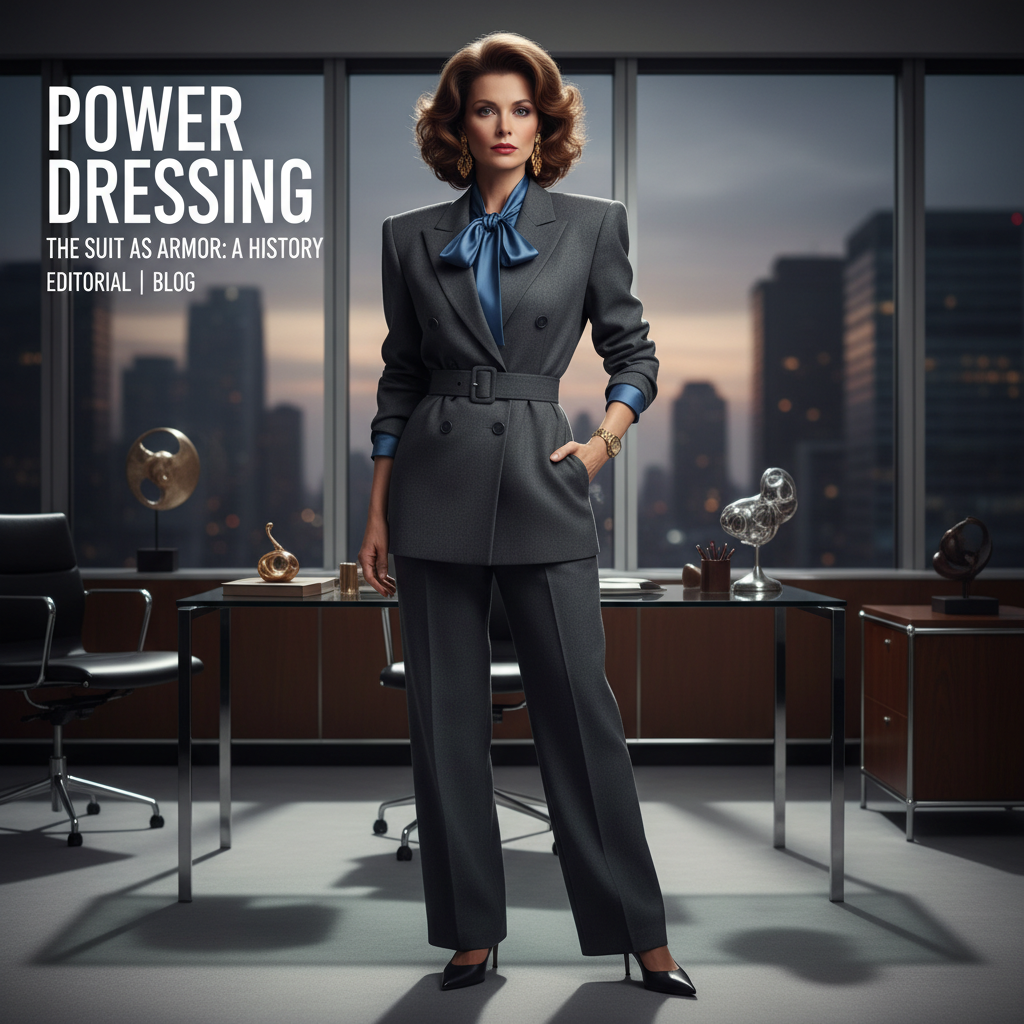
Power Dressing: The Suit as Armor – A History of Professional Style
In the lexicon of sartorial history, few garments carry the heavy semiotic weight of the suit. It is more than mere fabric stitched together; it is a declaration of intent, a manifestation of authority, and, in many respects, a form of psychological armor. The concept of “Power Dressing” and the idea of The Suit as Armor: A History of Power Dressing reveals a narrative that intertwines with the evolution of sociopolitical power structures, gender dynamics, and corporate warfare.
Clothing has always been a language. Psychologists refer to the phenomenon of “enclothed cognition”—the theory that the clothes we wear affect our psychological processes. When one dons a structured jacket, the posture corrects, the stride lengthens, and the demeanor hardens. The suit acts as a barrier between the soft vulnerability of the self and the harsh demands of the public sphere. To understand the suit as armor, we must look beyond the lapels and cuffs and examine the battles—both boardroom and societal—for which this uniform was designed.
This exploration traces the lineage of power dressing, from the sober frock coats of the Victorian industrialist to the broad-shouldered silhouettes of the 1980s, and finally to the deconstructed minimalism of the modern age. It is a story of how we protect ourselves while projecting the image of who we wish to be.
The Genesis of Authority: The Great Male Renunciation
The roots of the modern business suit lie in the early 19th century, a period fashion historians often refer to as the “Great Male Renunciation.” Before this era, men’s fashion was as ornate, colorful, and decorative as women’s. Silks, lace, and high heels were the province of the aristocracy. However, with the rise of the Industrial Revolution and the shifting of power from the landed gentry to the industrial capitalist, the aesthetic of power changed drastically.
Beau Brummell, the arbiter of Regency fashion, pioneered a shift toward bespoke tailoring, fit, and cleanliness over ornamentation. This evolved into the Victorian frock coat—a garment that was dark, sober, and imposing. It was the first iteration of the suit as armor. The heavy wools and stiff collars restricted movement, enforcing a rigid posture that communicated discipline and stoicism.

As seen in historical analyses by institutions like the Victoria and Albert Museum, the Victorian suit was designed to erase the individual in favor of the class. It turned the man into a monolith of industry. The color palette—charcoal, navy, black—mimicked the soot of the factories and the steel of the railways. It was a uniform that signaled serious intent; to wear it was to be a man of business, protected from the frivolities of emotion or leisure.
The Suffragette Suit: Armor for the Movement
While men codified their authority through the lounge suit, women began their own battle for sartorial armor in the early 20th century. The “Suffragette Suit” emerged not as a fashion statement, but as a tactical necessity. As women marched for the right to vote, they required clothing that allowed for movement and withstood the physical confrontations of protests, yet still commanded respect.
The suit became a symbol of emancipation. Coco Chanel in the 1920s further revolutionized this by borrowing heavily from men’s tailoring—specifically the materials like tweed and jersey—to create suits that freed women from the corset. However, it was during World War II that the “suit as armor” took on a literal meaning for women. With men at war, women entered the factories and offices. The “Utility Suit,” born of rationing and necessity, was sharp, angular, and devoid of excess. It was a uniform of resilience.
For a deeper dive into this transition, the Fashion Institute of Technology (FIT) provides extensive records on how the tailored jacket became a staple of the working woman’s wardrobe, signifying her entry into the public sphere previously dominated by men.
The Mid-Century Corporate Soldier
The 1950s solidified the concept of the “Company Man.” The grey flannel suit became the uniform of the corporate soldier. In post-war America, conformity was currency. The suit was armor against being singled out; it was camouflage for the climb up the corporate ladder. The cut was boxy, concealing the body, prioritizing the institution over the individual physique.
However, the 1960s and 70s brought disruption. The “Peacock Revolution” saw men embracing color and velvet, while Yves Saint Laurent introduced Le Smoking in 1966. This tuxedo for women was scandalous, erotic, and powerful. It appropriated the ultimate symbol of male privilege—the tuxedo—and tailored it for the female form. It was armor that didn’t hide the body but weaponized its allure.
In this era, accessories began to play a pivotal role in softening or sharpening the look. While the suit provided the steel, the choice of a bag or jewelry defined the individual. Even today, pairing a sharp blazer with a vintage beaded bag can subvert the rigidness of corporate attire, blending authority with personal narrative.
The 1980s: The Golden Age of Power Dressing
If the suit is armor, the 1980s was the era of the tank. This decade is the genesis of the term “Power Dressing” as we understand it today. The economic boom, the rise of the yuppie, and the entrance of women into upper management created a demand for a silhouette that was physically imposing.
Designers like Giorgio Armani and Thierry Mugler reconstructed the human form. The shoulders were widened with massive pads, the waists were nipped, and the lapels were aggressive. For women, this was a way to de-emphasize gender differences in the boardroom. By mimicking the male “V” silhouette, women’s power suits acted as camouflage in a male-dominated environment. It was an assertion of presence: “I am here, and I take up space.”

As noted in Vogue’s retrospective on the era, the power suit was synonymous with ambition. It appeared in pop culture staples like Working Girl and Dynasty. The fabric choices were often stiff wools or silks that held their shape, creating a literal hard shell. The colors were unapologetic: electric blues, reds, and stark blacks.
The BBC cultural analysis highlights that this era was about “dressing for success” in a Darwinian capitalist landscape. The suit was your shield against market volatility and corporate raiders.
Deconstruction and the Digital Shift
The 1990s and 2000s saw a dismantling of this rigidity. The “Business Casual” movement, born in Silicon Valley, began to view the suit not as armor, but as a cage. The tech titans—Jobs, Zuckerberg—equated suits with inefficiency and old-world thinking. Power dressing shifted from the structured jacket to the aggressively casual hoodie or turtleneck. The “armor” became the rejection of the armor.
However, the suit did not die; it evolved. Under Hedi Slimane and Thom Browne, the suit shrank. It became tighter, shorter, and more precise. The “Mad Men” effect in the late 2000s brought a nostalgia for the mid-century look, but with a modern, hyper-fitted edge.
Today, the concept of the suit as armor has fragmented. For the modern professional, “power” is often defined by quality and brand heritage rather than silhouette volume. A woman might pair an oversized blazer with a luxury accessory, such as a structured Polène bag, creating a look that signals knowledge of trends and financial status without the aggression of the 80s shoulder pad.
The Future: Psychological Armor in a Virtual World
In the post-pandemic world of Zoom calls and remote work, does the suit still function as armor? Surprisingly, yes. The return to tailoring we are witnessing in the 2020s is driven by a desire for structure in a chaotic world. The “Zoom Shirt”—business on top, comfort on bottom—proved that we still need the collar and the jacket to feel professional, even if only from the waist up.

Modern power dressing is gender-fluid and experimental. It borrows the protective elements of the past—double-breasted closures, heavy fabrics, sharp lines—but applies them with a new softness. We are seeing the rise of “soft armor”: unstructured jackets that drape rather than constrict, offering emotional comfort alongside professional projection.
The metaphor persists because the workplace remains a battlefield of ideas and status. Whether it is a vintage Chanel jacket or a bespoke Savile Row commission, the suit transforms the wearer. It covers our insecurities and projects a curated version of the self. As long as there are hierarchies to climb and impressions to be made, the suit will remain our most enduring form of armor.
Leave a Reply