The Ultimate Guide to Show, Don’t Tell: An Expert Analysis
Transform your flat, distant prose into an immersive, emotionally resonant narrative that captivates readers from the first page to the last.
Aspiring and experienced writers alike often face a common, frustrating problem: their stories feel flat. The prose is accurate, the plot is structured, but the narrative fails to connect with readers on a visceral level. It feels like a report, not an experience. This guide provides an expert review and analysis of the single most powerful technique to solve this problem: Show, Don’t Tell.
The Diagnosis: Why Your Story Feels Flat
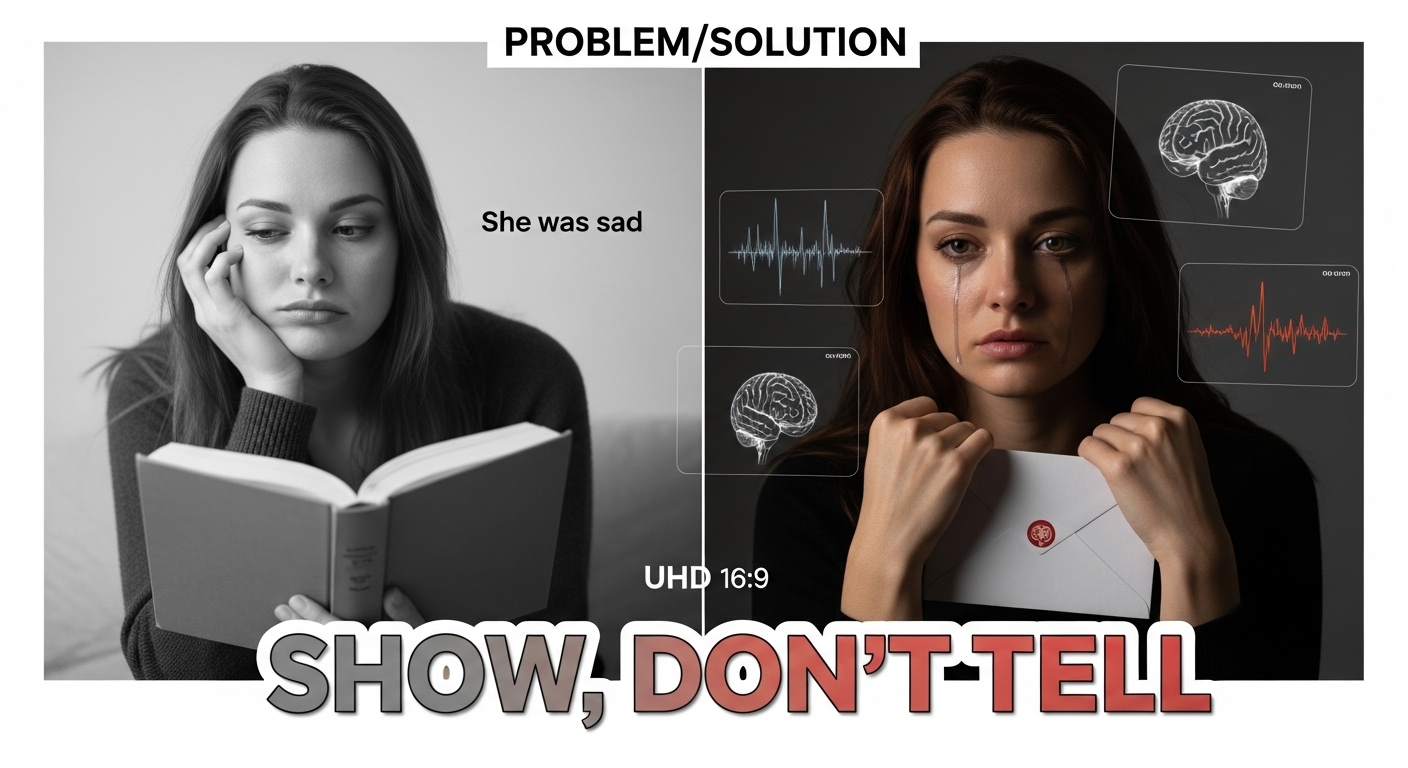
The core issue is often a reliance on “telling”—stating facts and emotions directly—rather than “showing,” which creates a sensory experience for the reader. Writing that tells (“She was nervous”) is passive and keeps the reader at a distance. Writing that shows (“Her knuckles whitened as she gripped the letter, her gaze darting toward the door”) invites the reader into the scene, making them an active participant in interpreting the character’s state of mind.
Expert Analysis
The modern reader’s brain is wired for immersive experiences. Groundbreaking research by neuroeconomist Paul Zak has shown that compelling, character-driven narratives cause the brain to release oxytocin, the “trust hormone.” This chemical fosters empathy and emotional connection. “Telling” simply presents data, but “showing” triggers this powerful neurochemical response, forging a bond between the reader and the characters.
Historical Review Foundation: From Chekhov to Hemingway
The principle of “Show, Don’t Tell” is not a new invention. Its roots are often traced back to Russian playwright Anton Chekhov. While the popular quote, “Don’t tell me the moon is shining; show me the glint of light on broken glass,” is likely a summary of his advice, the original sentiment from an 1886 letter to his brother holds the same power. Chekhov advised using small, concrete details—like “a piece of glass from a broken bottle glittered like a bright little star”—to paint a picture for the reader.
This idea marked a significant shift from the direct authorial narration common in Victorian literature to the more immersive techniques of Modernism. This philosophy was famously championed by Ernest Hemingway through his “Iceberg Theory.” Hemingway, drawing from his background as a journalist, believed that the most crucial elements of a story could be left unsaid, lying beneath the surface. By showing only the “tip of the iceberg,” the writer empowers the reader to feel the immense weight of what is omitted.

Specificity, as advised by Chekhov, is the heart of showing.
Current Review Landscape: Authenticity in the Age of AI
In 2025, the literary and business worlds are placing a higher premium on authenticity than ever before. As business leaders have noted, storytelling is a strategic asset that builds trust and connects with people on a deeper level. This is especially true as AI becomes more integrated into the creative process. While AI can generate plotlines and check grammar, it often lacks the lived experience and emotional nuance required for authentic storytelling, a topic explored in depth by the Wall Street Journal. This makes the human ability to “show” an experience—a skill AI cannot truly replicate—more valuable than ever. Readers are craving genuine, human-centric narratives, a demand that this timeless principle directly serves.
This video offers an excellent visual breakdown of the “Show, Don’t Tell” principle.
The Chekhov Method: Mastering Sensory Details
To move from telling to showing, you must engage the five senses. Instead of saying a room was “eerie,” describe the “strange shadows that danced on the cracked windows” and the “chilling draft that clawed its way through every room.” Don’t state that a character is hungry; show it through the “loud growl of their stomach as they eyed the freshly baked donuts.”
Actionable Tip: The Five Senses Exercise
Take a simple “telling” sentence like “The forest was quiet.” Now, rewrite it five times, with each version focusing on a different sense. This exercise is one of many creative writing prompts that can train your brain to think in sensory details.

Engaging all five senses creates a truly immersive world for your reader.
Showing Emotion: The Body Language Blueprint
One of the most common pitfalls for writers is telling emotions. We say a character is “angry” or “sad.” To show emotion, you must translate it into physical action and body language. Emotion is physical. A character’s internal state is revealed through their posture, gestures, and expressions.

Show emotion in the body, not just in the character’s thoughts.
Comparative Analysis: Emotion
| Telling | Showing |
|---|---|
| She was terrified. | She felt the knot in her stomach tighten. Prickling beads of sweat formed on her forehead. |
| He was bored. | He yawned lazily and glanced at the clock for the tenth time in as many minutes. |
| She was nervous. | She fidgeted, tapped her foot, and paced back and forth across the room. |
Dialogue with Subtext: What Isn’t Said
Powerful dialogue is rarely about what is being said directly. It’s about the subtext—the unspoken thoughts and feelings simmering beneath the surface. Show the conflict between a character’s words and their actions. A character might be smiling, but their hands under the table are shredding a napkin into confetti. This contrast between dialogue and action is where true character is revealed.

What isn’t said is often more important than what is.
Pacing & Flow: Balancing Scene and Summary
It’s a common misconception that you should *never* tell. “Telling” has its place, particularly in summaries that cover long periods or unimportant events to maintain narrative pacing. The key is balance. You “show” the crucial, emotionally charged moments (the scenes) and “tell” the transitions between them (the summary).

Summarize what’s unimportant. Immerse the reader in the moments that matter.
This video provides more examples of transforming “telling” into “showing.”
The “Show, Don’t Tell” Editing Checklist
Once you’ve completed your first draft, it’s time to hunt for instances of “telling” and transform them. Use this checklist during your editing process, a process that can be aided by a great tool like the AI Studio. If you want to contribute your own writing insights, you can Write With Us.
- Adverb Hunt: Search for words ending in “-ly” (e.g., “angrily,” “sadly”). Can you replace them with a physical action?
- Emotion Words: Highlight every instance where you name an emotion (e.g., “happy,” “scared,” “excited”). Rewrite these sentences to show the emotion through action, dialogue, or internal thought.
- Abstract Nouns: Look for vague, abstract concepts like “beauty,” “freedom,” or “despair.” How can you represent these ideas through concrete, sensory details?
- Sensory Check: Does your scene engage at least two or three of the five senses? If not, what can you add to make it more vivid? For more on editing, you can check out resources like the AI Studio Tutorial.
For those looking to deepen their craft, “Show, Don’t Tell” by Sandra Gerth is an excellent resource, available here: Get the book on Amazon.

The tools may change, but the principles of great storytelling remain.
Final Verdict & Recommendations
Expert Verdict
Mastering “Show, Don’t Tell” is not just about following a rule; it is about fundamentally shifting your mindset from that of a reporter to that of a storyteller. It’s the difference between a story that is read and a story that is *felt*. By prioritizing sensory details, physical actions, and subtext, you create an immersive experience that respects the reader’s intelligence and engages their emotions on a profound level. While telling has a strategic role in pacing and summary, showing is the engine of emotionally resonant fiction. Embrace this technique, practice it diligently, and watch your writing transform.
Sources and Further Reading
Internal Links
- Write With Us
- AI Studio Review
- AI Studio Key
- AI Studio Tutorial
- Mindful Morning: The Ultimate Routine to End Chaos Now
- How AI is Revolutionizing the Fashion Industry
Historical Authority Links
- Quote Investigator: An exploration of the famous Chekhov quote.
- Wikipedia: Hemingway’s Iceberg Theory.
- Well-Storied: A breakdown of the history and application of “Show, Don’t Tell.”
Latest News Authority Links
- Forbes: The Power Of Storytelling In Business (2025)
- Wall Street Journal: AI in Creative Writing
- Written Word Media: Publishing Trends for 2025
- DISRUPTS: The Neuroscience of Storytelling (2025)
- Pageleaf Publishing: Future of Publishing Trends (2025)
- Reuters: Latest News on Artificial Intelligence
- Associated Press: AI News Hub
- BBC News: Technology Section
Leave a Reply