Sneaker Culture: From the Court to the Catwalk – Evolution & History
What began as a utilitarian solution for athletes has metamorphosed into a global economic powerhouse and a definitive pillar of modern luxury. The trajectory of sneaker culture—from the court to the catwalk—is not merely a story of footwear; it is a chronicle of sociological shifts, the commodification of subculture, and the blurring lines between streetwear and high fashion.
Today, the sneaker industry is valued at tens of billions of dollars, driven by a fervent community of collectors, investors, and fashion enthusiasts. However, to understand how a rubber-soled shoe became a canvas for avant-garde expression and a status symbol rivaling Swiss watches, we must delve into the gritty pavement of the 20th century, the explosive influence of basketball, and the audacious vision of designers who dared to elevate athletic wear to the level of fine art. This is the story of sneaker culture.
The Genesis: Rubber, Canvas, and Utility
The history of the sneaker dates back to the 19th century, far removed from the hype cycles of today. The innovation began with the vulcanization of rubber by Charles Goodyear, a process that made rubber durable and heat-resistant. This technological leap allowed for the creation of the “plimsoll,” a rudimentary beach shoe with a rubber sole and canvas upper. By 1916, Keds began mass-producing these shoes, marketing them as sneakers because the rubber soles allowed the wearer to “sneak” around silently.
However, the true athletic application began with the Converse All Star in 1917. Endorsed by basketball player Chuck Taylor in the 1920s, this silhouette became the standard for the emerging sport of basketball. For decades, sneakers were strictly functional. They were equipment, not statements. The divergence began in post-war Europe, where the rivalry between Adi Dassler (Adidas) and his brother Rudolf (Puma) pushed innovation in soccer cleats and track spikes. Yet, culturally, the sneaker remained on the field, rarely crossing over into the daily wardrobe of the sophisticated gentleman or the fashion-conscious woman.
The 1980s: The Concrete Catwalk
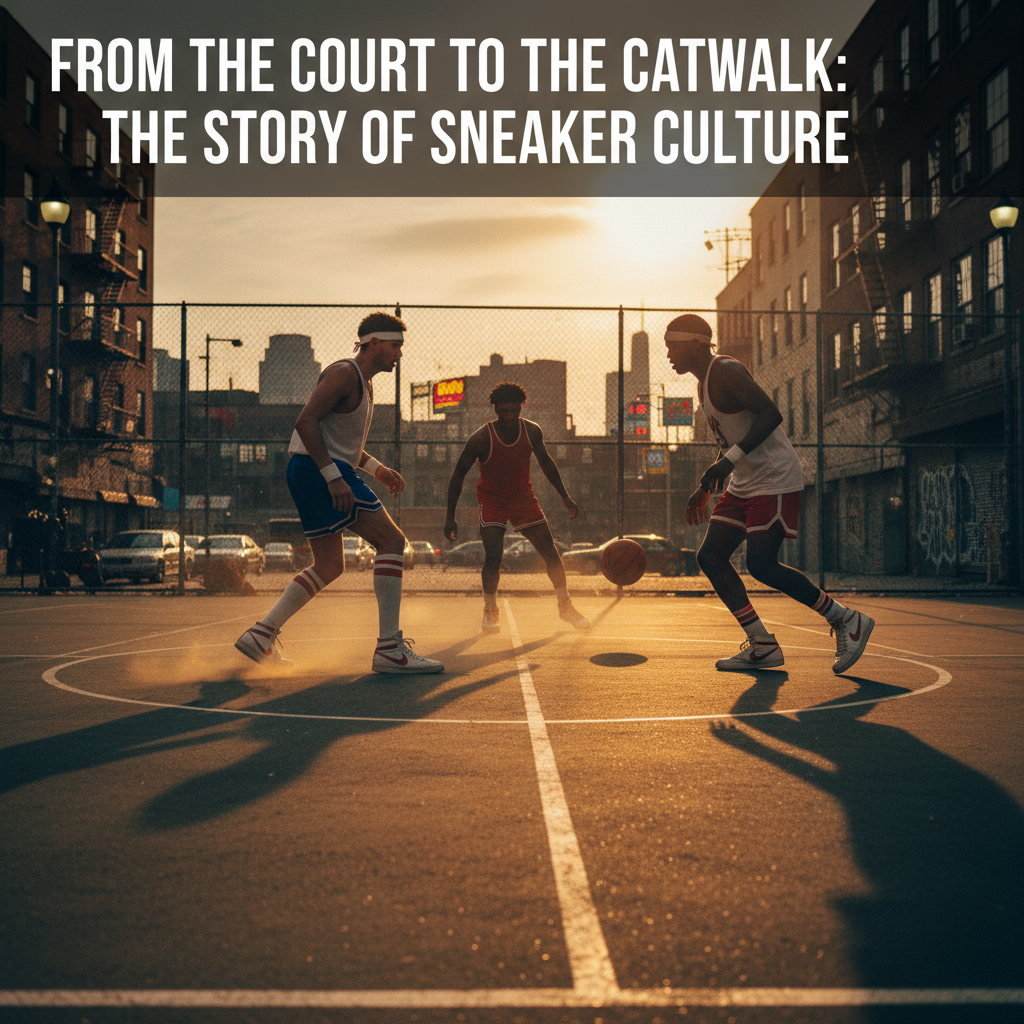
The seismic shift in sneaker culture occurred in the 1980s, a decade defined by the collision of two powerful cultural forces: hip-hop and basketball. This era moved the sneaker from the gymnasium to the city streets, transforming it into a badge of identity.

In 1984, Nike took a gamble on a rookie named Michael Jordan. The Air Jordan 1 was banned by the NBA for violating uniform regulations, a controversy Nike masterfully exploited. The “banned” narrative birthed the concept of the “hype” sneaker. Suddenly, sneakers were rebellious. They were counter-culture. Owning a pair of Jordans wasn’t just about supporting a player; it was about aligning oneself with excellence and defiance.
Simultaneously, in New York City, Run-D.M.C. released “My Adidas,” an anthem that stripped the sneaker of its athletic context and firmly planted it in hip-hop culture. They wore their Superstars without laces, tongue out—a style derived from prison culture, recontextualized as a symbol of street toughess and style. This was the moment the “court” aesthetic began its migration. The sneaker became a canvas for self-expression, a signal of knowing “what’s up.”
For those interested in the deep historical archives of these movements, the Brooklyn Museum’s retrospective on the Rise of Sneaker Culture offers an academic look at these pivotal years.
The Rise of the Sneakerhead and the Resale Economy
As the 90s progressed into the 2000s, the “collector” mindset emerged. The introduction of the internet and forums like NikeTalk created global communities. No longer isolated to pockets of New York, London, or Tokyo, enthusiasts could share knowledge, trade rare pairs, and build the lore of specific silhouettes.
This era saw the birth of the “drop” model—limited supply releases that created artificial scarcity. Nike SB (Skateboarding) was instrumental here, collaborating with artists like Futura and Jeff Staple. The 2005 release of the Jeff Staple “Pigeon” Dunk in New York City resulted in riots, making the front page of the New York Post. This was the moment the mainstream media realized sneakers were a serious commodity.
The resale market exploded. What was once a hobby of trading used pairs became a multi-billion dollar secondary market. Platforms like StockX and GOAT turned sneakers into tradeable assets, often outperforming traditional stocks. However, this commodification brought challenges. The market became flooded with counterfeits. Just as one might scour the web to identify the best AAA replica sites to avoid scams or understand the market’s underbelly, sneakerheads had to become authenticators, studying stitching and glue patterns with forensic intensity.
Elevation to High Art: The Contemporary Era
If the 80s were about the street, the 2010s were about the studio. The barrier between “streetwear” and “luxury” began to dissolve, largely due to the influence of visionaries like Kanye West and Virgil Abloh. West’s transfer from Nike to Adidas to create the Yeezy line demonstrated that a non-athlete could drive sneaker culture with the same potency as Michael Jordan.

Virgil Abloh’s “The Ten” collection with Nike deconstructed the most iconic silhouettes of the past, stripping them back to their industrial essence. This approach treated the sneaker not as a shoe, but as an object of design—a sculpture. Sneakers began appearing in art galleries and auction houses like Sotheby’s, fetching prices formerly reserved for vintage wine or fine jewelry.
The appreciation of craftsmanship in sneakers now rivals that of traditional leather goods. Much like the intricate beadwork discussed in our analysis of the classic beaded bag, modern high-end sneakers feature complex materials, from pony hair to Italian tumbled leather.
The Catwalk Conquest: Luxury Brands Capituatlate
Historically, luxury fashion houses like Chanel, Gucci, and Dior looked down on the sneaker. It was viewed as pedestrian, the antithesis of the hard-bottomed shoe or the heel. However, the spending power of the millennial and Gen Z demographic forced a reckoning.
The turning point arguably came when Balenciaga released the Triple S. A bulky, “ugly” dad shoe, it retailed for nearly $1,000 and sold out instantly. It proved that the high-fashion consumer craved the comfort and aesthetic of street culture. Soon, Gucci unleashed the Ace, and Louis Vuitton, under the direction of Virgil Abloh, released the LV Trainer.

The ultimate synthesis occurred with the Dior x Air Jordan 1 collaboration. Here was the quintessential basketball shoe, made in Italy with Dior’s leather and branding, selling for $2,000 at retail and $10,000 on the resale market. This collaboration cemented the narrative: the sneaker had officially traveled from the gritty asphalt of the court to the pristine runway of the catwalk.
The quality of these luxury sneakers invites comparison to the finest leather goods. When examining the structural integrity of a Polene bag versus a luxury sneaker, one finds similar attention to stitching, grain quality, and hardware. The sneaker is no longer just footwear; it is a piece of leather luggage for the feet.
The Future: Sustainability and Digital Frontiers
As we look forward, sneaker culture faces an existential crisis regarding sustainability. The production of sneakers is resource-intensive, involving plastics, glues, and ethical labor concerns. Brands are responding with circular economy models. Adidas’s “Futurecraft.Loop” aims for a fully recyclable shoe, while Nike’s “Space Hippie” line utilizes factory waste.
Furthermore, the culture is entering the metaverse. RTFKT studios and Nike are pioneering digital sneakers (NFTs) that exist only on screen. While controversial, this represents the next logical step in “flexing”—displaying status in the digital realms where the next generation spends their time. You can read more about current trends at Complex Sneakers or Highsnobiety.
“The sneaker is the canvas of our generation. It is where art, commerce, and identity intersect most violently and most beautifully.”
Conclusion
From the canvas Chuck Taylors of the 1920s to the digital assets of the 2020s, the story of sneaker culture is one of constant reinvention. It is a story of how the marginalized aesthetic of the inner-city court conquered the exclusive world of the Parisian catwalk. It proves that culture bubbles up from the streets, it doesn’t trickle down from the towers.
Whether you are a collector with a vault of deadstock Jordans or a fashion enthusiast rocking Balenciagas, you are participating in a global dialogue—a shared language spoken through the soles of our feet.
Leave a Reply