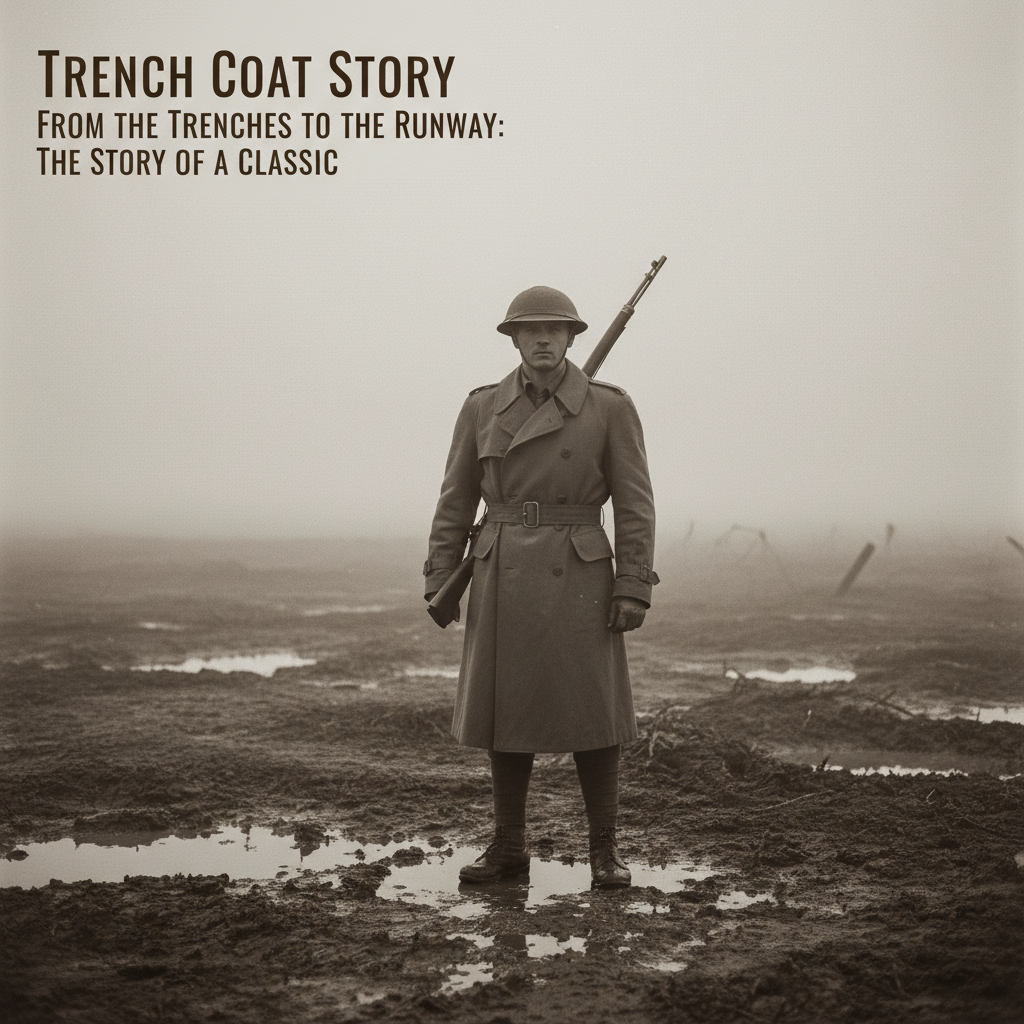
The Trench Coat Story: From WWI Trenches to High Fashion Icon
Few garments in the lexicon of modern fashion possess a history as pragmatic, violent, and undeniably stylish as the trench coat. It is a paradox of design: a garment forged in the mud and blood of the First World War that somehow transitioned seamlessly into the glitz of Hollywood and the avant-garde runways of Paris. The silhouette is unmistakable—the double-breasted front, the wide lapels, the belted waist, and the storm flaps. Yet, when we zip up a windbreaker or button a pea coat, we rarely consider the lineage. The trench coat, however, demands that we acknowledge its past. To explore the Trench Coat Story: From the Trenches to the Runway is to explore a century of human history, from the industrial revolution’s textile breakthroughs to the silver screen’s definition of “cool.”
While today we might pair this garment with a Polene bag for a chic Parisian look or drape it over evening wear, its genesis was strictly utilitarian. It was born not of vanity, but of necessity. The story of this classic begins long before the first shot of 1914 was fired, rooted in the rainy climate of Great Britain and the scientific pursuit of waterproofing.
Chapter 1: The War on Weather (Pre-1914)
To understand the trench coat, one must first understand the “Mac.” In the early 19th century, keeping dry was a heavy, smelly affair. Charles Macintosh had invented a rubberized cotton fabric in 1823. While it was waterproof, it was also non-breathable, causing the wearer to sweat profusely, and it had a distinctively unpleasant odor. The British military and gentlemen of the era needed something better.
Enter two titans of British tailoring: Aquascutum and Burberry. The debate over who truly “invented” the trench coat is a fashion rivalry that persists to this day. Aquascutum (Latin for “water shield”) was founded by John Emary, who developed a waterproof wool in 1853. However, the game changed in 1879 when a young draper named Thomas Burberry invented gabardine.
Gabardine was revolutionary. Instead of coating the finished fabric in rubber, Burberry waterproofed the individual yarn strands—Egyptian cotton or wool—before weaving them tightly. The result was a fabric that repelled water but allowed air to circulate. It was lightweight, durable, and silent. According to Burberry’s heritage archives, this fabric was quickly adopted by explorers like Roald Amundsen and Ernest Shackleton. But the true test of gabardine would not be the South Pole; it would be the Western Front.

Chapter 2: The Trenches (1914-1918)
When World War I began, British officers were still wearing heavy greatcoats made of thick wool. These were warm when dry, but in the waterlogged trenches of France and Belgium, they became deadly sponges. They absorbed water and mud, weighing down officers who needed mobility. The War Office recognized the need for a modern alternative.
The “Trench Warm” or “Trench Coat” was not standard issue for the rank-and-file soldier; it was an optional purchase for officers (Warrant Officers Class I and above). Officers would visit tailors on Savile Row or the Haymarket to commission their kit. The design was adapted specifically for the harrowing conditions of modern warfare. Every feature of the classic trench coat that we see today on a fashion replica site or a high-end boutique rack was originally a life-saving tool.
Anatomy of Survival: Functional Features
- The D-Rings: Located on the belt, these weren’t for cinching the waist tighter. They were load-bearing anchors for map cases, swords, field glasses, or hand grenades.
- The Gun Flap: The extra flap of fabric on the right shoulder (for men) served as padding for the recoil of a rifle and prevented water from running into the gun when it was shouldered.
- The Storm Shield: The cape-like back yoke was designed so that rain would roll off the shoulders and away from the body, rather than soaking into the back of the coat.
- Epaulettes: These shoulder straps held rank insignia, but also secured other equipment like gas mask satchels or binoculars.
- Wrist Straps: Officers could tighten these to prevent rain from running down their forearms while using binoculars or raising a weapon.
As noted by the Smithsonian Magazine, over 500,000 Burberry trench coats were worn during the war. By the time the armistice was signed in 1918, the coat had become a symbol of veteran status. Returning officers kept their coats, wearing them in civilian life. The fabric that had deflected the mud of the Somme was now deflecting the rain of London’s streets, carrying with it an aura of heroism and stoic masculinity.
Chapter 3: Noir, Spies, and Hollywood Glamour
If the First World War gave the trench coat its form, Hollywood gave it its soul. In the interwar years and following WWII, the coat transitioned from military surplus to a narrative device. Costume designers realized that the trench coat was the perfect garment for hiding something—be it a weapon, a secret, or a broken heart.
The 1940s brought the era of Film Noir. In high-contrast black and white, the trench coat caught the light of streetlamps and the shadows of alleyways. It became the uniform of the hard-boiled detective and the femme fatale. When Humphrey Bogart bid farewell to Ingrid Bergman in Casablanca (1942), his trench coat was as much a part of the scene as the fog. It signaled a man who was world-weary, tough, yet fundamentally noble.
According to Vogue’s history of the garment, the coat’s gender barriers were shattered during this golden age. While Marlene Dietrich and Greta Garbo had adopted the look earlier, it was Audrey Hepburn in Breakfast at Tiffany’s (1961) who cemented the trench coat as a quintessential item for women. In the final rain-soaked scene, the trench coat protects her, but also highlights her vulnerability. It ceased to be just armor; it became a layer of mystery.
“The trench coat is the ultimate equalizer. It wraps the spy, the soldier, the lover, and the banker in the same gabardine embrace.”
Through the lens of pop culture, the coat evolved. In the 60s, it was worn by French New Wave icons like Alain Delon. In the 70s and 80s, it took a darker turn, associated sometimes with counter-culture or the gritty realism of urban thrillers. Yet, it never lost its association with authority and competence.
Chapter 4: Modern Reinvention and The Runway
As we moved into the late 20th and early 21st centuries, the trench coat faced a risk of becoming a relic. However, fashion thrives on reinvention. Christopher Bailey, during his tenure at Burberry, is largely credited with revitalizing the trench coat for the millennial generation. He deconstructed the classic: cropping it, coloring it in metallics, rendering it in lace, and tailoring it to a slimmer, more modern silhouette.
Today, the Trench Coat Story: From the Trenches to the Runway is a narrative of limitless variation. Designers like Rei Kawakubo (Comme des Garçons) and Demna Gvasalia (Balenciaga) have distorted the shape, creating oversized, architectural pieces that challenge the very definition of the coat. It is no longer just beige gabardine. It is leather, vinyl, denim, and silk.
We see the influence of the trench in accessories as well. The structure and hardware often inspire other fashion items, such as the meticulous detailing found on a beaded bag or the rugged utility of modern travel gear. The concept of “functional luxury” that began in the trenches is now the standard for high-end ready-to-wear.
In contemporary fashion, the trench coat serves as a canvas. For the sustainable fashion movement, vintage trench coats are prized possessions, durable enough to last decades and easily upcycled. BBC Culture notes that the garment’s longevity is a key part of its appeal in an era of fast fashion; it is a purchase made for a lifetime.
Chapter 5: How to Choose a Classic
With a century of history behind it, buying a trench coat is an investment. Whether you are looking for a heritage piece or a modern interpretation, there are key elements to look for to ensure you are getting the true “Trench” experience:
- Fabric: Look for tightly woven cotton gabardine for the most authentic experience. It breathes better than synthetics and ages beautifully.
- The Fit: A classic trench should be roomy enough to wear over a blazer or thick sweater. If it’s too tight in the shoulders, the storm flaps won’t lay flat.
- Length: While cropped versions exist, the traditional length hits just above or below the knee. This provides the ideal balance of protection and mobility.
- Details: Check for the functional details. Even if you never use the gun flap for a rifle, its presence adds structure to the shoulder line.
Conclusion
From the muddy fields of the Somme to the cinematic rain of Hollywood, and finally to the bright lights of Fashion Week, the trench coat has traveled further than perhaps any other garment in history. It is a survivor. It adapts. It protects.
The Trench Coat Story: From the Trenches to the Runway is not just about clothes; it is about how we present ourselves to the world. We wear it to look professional, to look mysterious, or simply to stay dry. But in every button and belt loop, there is an echo of the past—a reminder that true style is born from purpose.
Frequently Asked Questions
The name is derived directly from the coat’s widespread use by British officers in the trenches of the Western Front during World War I. While waterproof coats existed prior to 1914, the modifications made specifically for trench warfare cemented the name in history.
The invention is a contested topic between two British luxury houses: Aquascutum and Burberry. Aquascutum claims to have developed the first waterproof wool in 1853, while Thomas Burberry invented gabardine, a breathable waterproof fabric, in 1879. Both supplied coats to the military.
Originally, the D-rings attached to the belt were functional military hardware used to secure equipment such as map cases, swords, or grenades, preventing them from swinging loosely while soldiers moved.
Absolutely. The trench coat is considered a “wardrobe staple” that transcends seasonal trends. While designers may alter the cut, color, or material, the fundamental silhouette remains a symbol of sophistication and is a permanent fixture in global fashion.
Leave a Reply